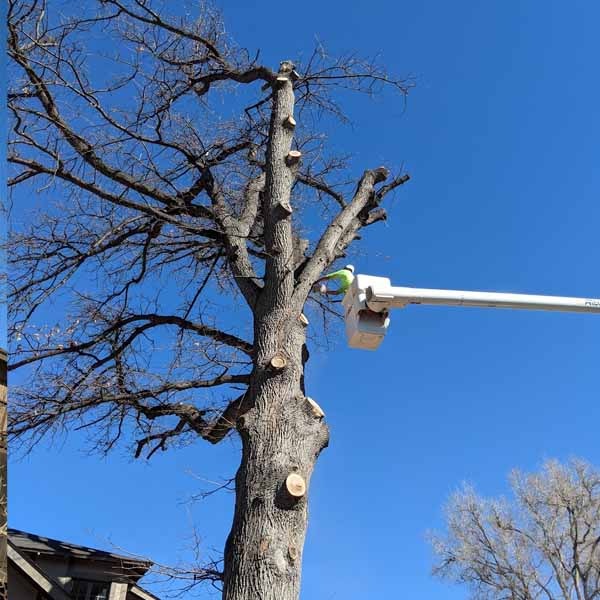
36 million trees fall in U.S. cities every year — more than all the harvested wood in National Forests combined.
67% of urban wood gets chipped into mulch. Most of the rest goes to landfill.
10%+ of all waste generated in North America is wood. Most of it is urban.
Every year, Denver loses thousands of trees. They come down in storms, fall to disease, get removed for construction, or simply reach the end of their lives. And almost every one of them — including trees that have been growing for 50, 80, or 100 years — ends up in a chipper.
The wood from those trees is remarkable. Urban trees grow slowly, often in challenging conditions, producing dense, tight-grained timber with character you rarely find in commercially harvested lumber. A backyard walnut. A boulevard elm. A cottonwood that shaded a front porch for three generations. These are not waste materials. They’re extraordinary raw wood waiting for someone who knows what to do with them.
And we do.
What we do with Denver’s urban trees
Denver Wood Slabs has been salvaging and milling urban trees from across the Front Range since 2007. When a tree comes down — whether from a development project, disease, age or a storm — we work with property owners and tree companies to recover the logs before they’re chipped.
We mill them, store them while they come down in moisture, and then kiln-dry everything in our vacuum kiln. The result is stable, sterilized, ready-to-work wood — slabs for dining tables, counters, bar tops, and wall art; cookies and stumps for table bases and sculptural pieces. Material that would have become mulch becomes something that lasts for generations.
Not all our wood is locally sourced — we also bring in select species like black walnut, white oak, and ash from Midwest and East Coast suppliers when local supply runs short. Everything, regardless of origin, runs through our vacuum kiln before it leaves our warehouse.
Why kiln drying matters for urban wood
Urban trees present unique challenges compared to commercially harvested timber. They often contain embedded metal — old fence staples, forgotten nails, wire. They’ve grown in variable conditions. And they need to be properly dried before they’re used to make furniture.
Our vacuum kiln brings wood down to a stable moisture content suited to Colorado’s dry climate — preventing cracking, eliminating insects, and making the wood ready to finish and build with. Air-dried urban wood is unpredictable. Kiln-dried urban wood is a premium material.
At 5,280 feet, Denver’s dry climate creates unique challenges for wood stability. Wood that arrives from humid East Coast or Midwest suppliers is often over-saturated for Colorado conditions — it will continue to shrink after installation. Our vacuum kiln dries everything to moisture content calibrated specifically for Colorado’s climate, whether the log came from a Denver backyard or the Midwest.
The bigger picture
Denver Wood Slabs is part of a national movement. The Urban Wood Network — of which we are proud members — connects municipalities, sawyers, woodworkers, and businesses working to divert urban wood from the waste stream and turn it into something valuable.
Cities like Stoughton, Wisconsin and Harrisonburg, Virginia have built formal urban wood programs that save tens of thousands of dollars in landfill fees annually while supplying local woodworkers, schools, and community organizations with premium local material. Denver has the same opportunity — and the same remarkable trees.
What this means for your project
When you buy a slab from Denver Wood Slabs, you’re not buying imported lumber or commodity wood. You’re buying a piece of Colorado — a tree that grew in a Denver neighborhood, milled and dried by the same people who sell it to you, at a price that reflects the direct relationship between the source and the sale.
Every piece has a story. The honey locust that came from a downtown corner city lot. The elm that shaded a backyard in Park Hill for sixty years. The walnut that a family wanted to keep rather than chip.
Want to learn more about what’s in our current inventory, or find out more about our process?